 Code Heaven
What Is Agentic Appointment Booking?
By Code Heaven
The appointment booking industry has gone through three distinct phases. First came paper calendars and phone calls. Then came online booking forms — the click-through wizards that dominate WordPress today. Now, a third wave is emerging: agentic booking.
If you have not heard the term before, you are not alone. Agentic booking is a new category, and it describes something fundamentally different from both traditional forms and simple chatbots. This article defines what it means, how it works, and why it matters for businesses that rely on appointments.
What Does "Agentic" Mean in Booking?
In AI, "agentic" refers to systems that can autonomously take actions to achieve a goal, rather than just responding to prompts. An agentic system does not wait for step-by-step instructions — it understands the objective and figures out the path.
Applied to appointment booking, agentic means an AI system that:
Understands your business context. It knows your services, pricing, staff schedules, locations, and availability — not because you trained it on a FAQ document, but because it has real-time access to your booking data.
Takes real actions. It does not just collect information. It creates appointments, processes payments, reschedules bookings, and updates records in your actual system.
Makes decisions. When a customer says "I need a massage next week," the agent checks availability across staff and locations, considers service durations, and proposes specific options — without being explicitly told to check each variable.
Handles multi-step workflows. Booking is not a single action. It involves service selection, availability checking, customer identification, confirmation, and payment. An agentic system orchestrates this entire workflow conversationally.
The key distinction is autonomy with guardrails. An agentic booking system acts on its own but always confirms critical actions (like creating an appointment or processing payment) with the user before executing them. It is not a fully autonomous agent making decisions without human oversight — it is a capable assistant that proposes and executes with consent.
Traditional vs Chatbot vs Agentic Booking
To understand why agentic booking matters, it helps to see where it sits in the evolution:
Traditional Form-Based Booking
The customer navigates a multi-step wizard: select service, pick staff, choose date/time, fill in details, submit. The form is static — it does not adapt to the customer, cannot answer questions, and offers no flexibility in the order of steps.
Strengths: Predictable, well-understood, works offline.
Weaknesses: High abandonment rates, no personalization, no way to ask questions during the process, painful on mobile.
Chatbot-Based Booking
A chatbot widget asks scripted questions in sequence: "What service would you like?" then "What date works?" then "What is your name?" The conversation follows a fixed decision tree. If the customer says something unexpected, the bot either loops back or fails.
Strengths: Feels more conversational than a form, available 24/7, can handle simple linear flows.
Weaknesses: Cannot handle complex requests, no real-time data access, breaks on unexpected input, requires manual maintenance of scripts, no payment capability.
Agentic Booking
The AI understands natural language, has live access to business data, and takes actions within the booking system. A customer can say "Do you have anything for a couples massage next Saturday afternoon?" and the agent checks availability for the relevant service, filters by the requested date and time range, and presents real options — all in a natural conversation.
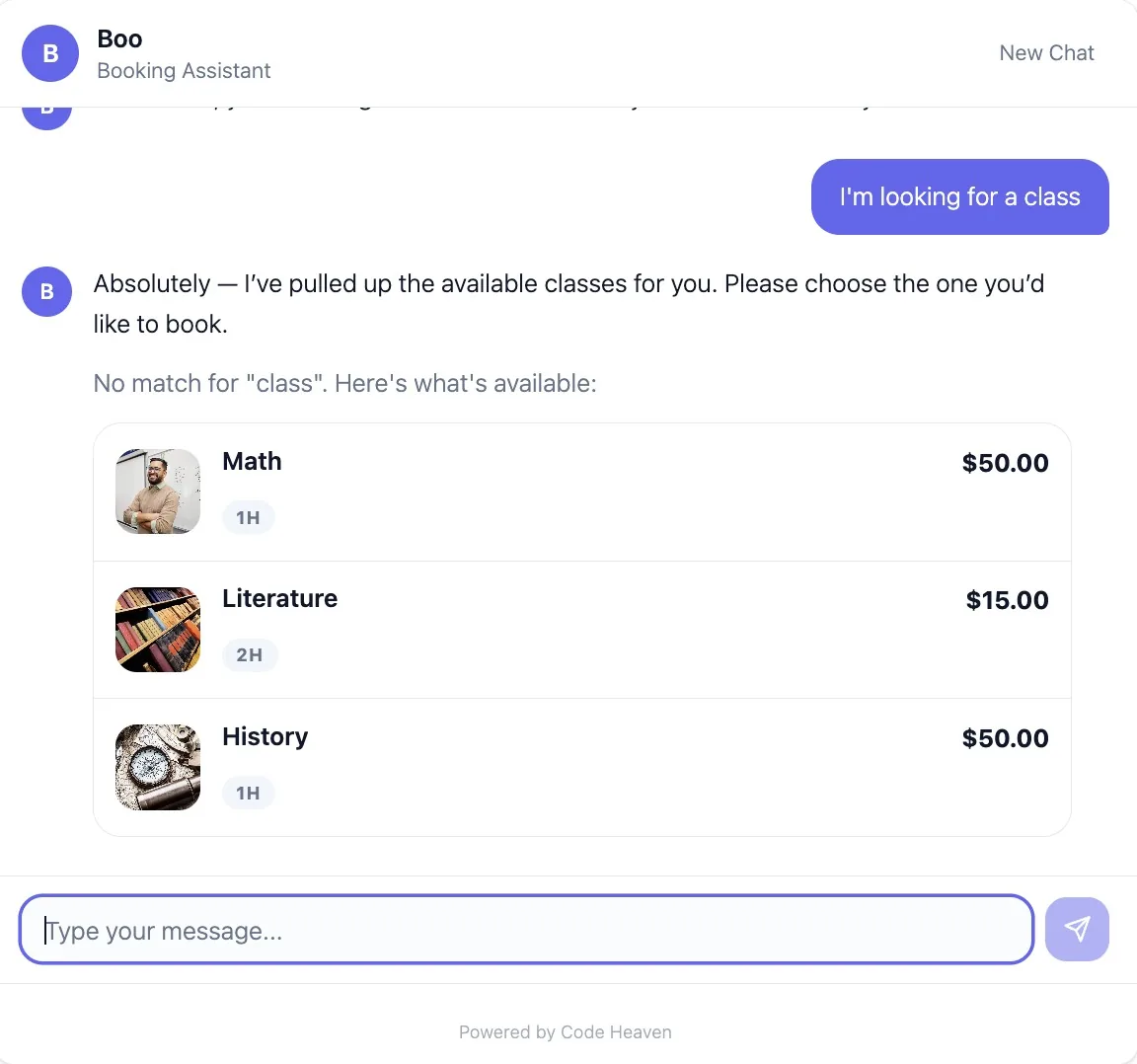
Boo AI understanding a natural language request and presenting relevant services.
Strengths: Natural language understanding, real-time data, multi-step action execution, payment in chat, adapts to any conversation flow.
Weaknesses: Newer technology, requires integration with a booking system, subscription cost.
Key Characteristics of Agentic Booking Systems
Not every AI-powered booking tool is agentic. Here are the characteristics that define a truly agentic system:
1. Tool use. An agentic system has access to structured tools — APIs that can read and write data in your booking system. This is different from an AI that has been fine-tuned on your FAQ. Tool use means the AI calls specific functions: check_availability(), create_appointment(), process_payment(). Each tool does one thing, and the AI decides which tools to use and in what order.
2. Context persistence. The conversation maintains context across multiple turns. If a customer asks about a service, then changes their mind, the agent does not lose track. It remembers what was discussed and adjusts accordingly.
3. Multi-step reasoning. Booking requires a chain of decisions. The agent must determine what service the customer wants, check which staff can provide it, find available time slots, calculate pricing (including extras and deposits), and coordinate payment — all while maintaining a natural conversation.
4. Graceful uncertainty handling. When the agent encounters ambiguity — "I want a haircut, whatever is cheapest" — it does not fail. It searches services, compares prices, and recommends options. A chatbot would say "Please select from the following" and dump a full list.
5. Confirmation before action. Agentic does not mean autonomous. Before creating an appointment or processing payment, the system presents a summary and asks for explicit confirmation. This is a critical safety guardrail.
How Boo AI Implements Agentic Booking
Boo AI is, to our knowledge, the first WordPress plugin to implement fully agentic booking for Booknetic. Here is how the characteristics above translate into practice:
Tool access: Boo AI has 31 tools for the admin chat (covering appointments, staff, services, locations, customers, analytics) and a full booking toolkit for the customer chat. The AI selects which tools to use based on the conversation.
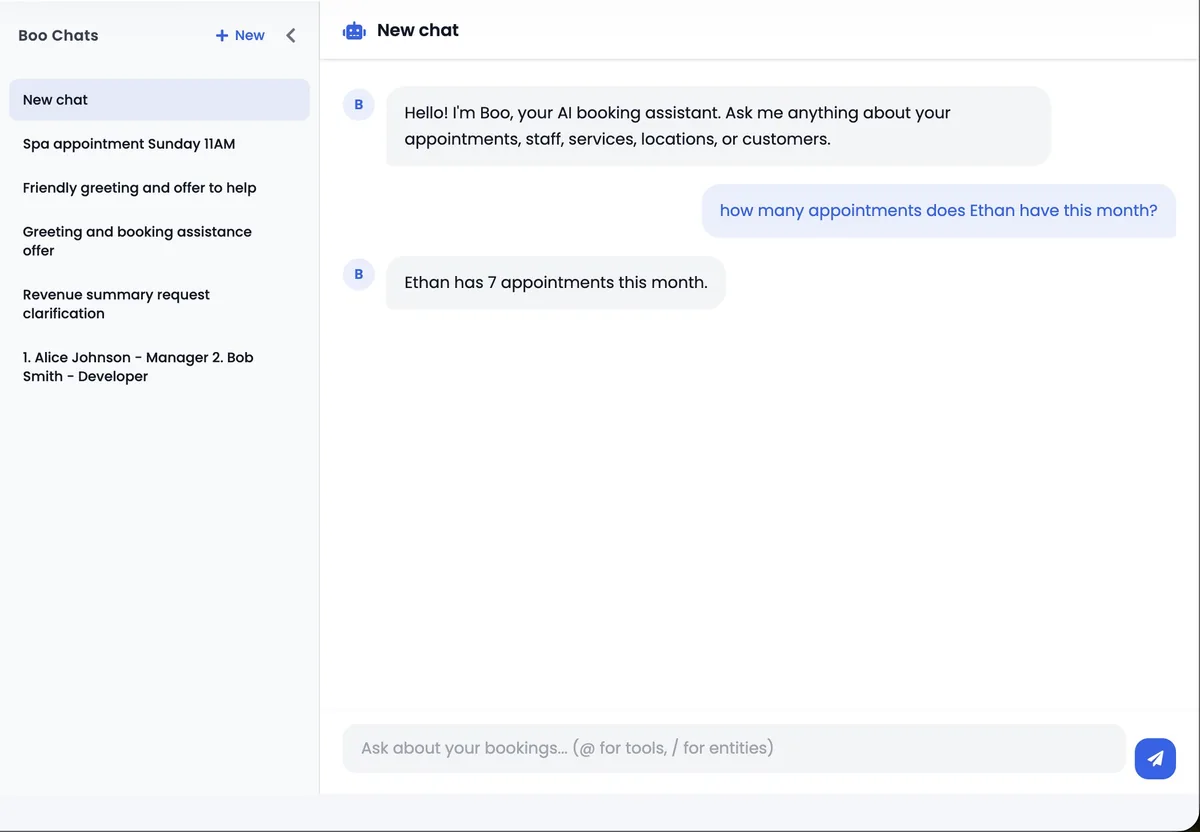
The admin chat using multiple tools — ask about revenue, appointments, or staff in one conversation.
Context persistence: Conversations are maintained via WebSocket with session storage. Customers can refresh the page and resume where they left off. Admins have a sidebar of past conversations, each auto-titled based on content.
Multi-step reasoning: The customer booking flow involves up to 7 steps (service, staff, location, date/time, extras, customer info, payment), and Boo AI navigates through them based on the conversation — skipping steps that are not relevant, reordering based on what the customer says first, and presenting interactive UI components at each stage.
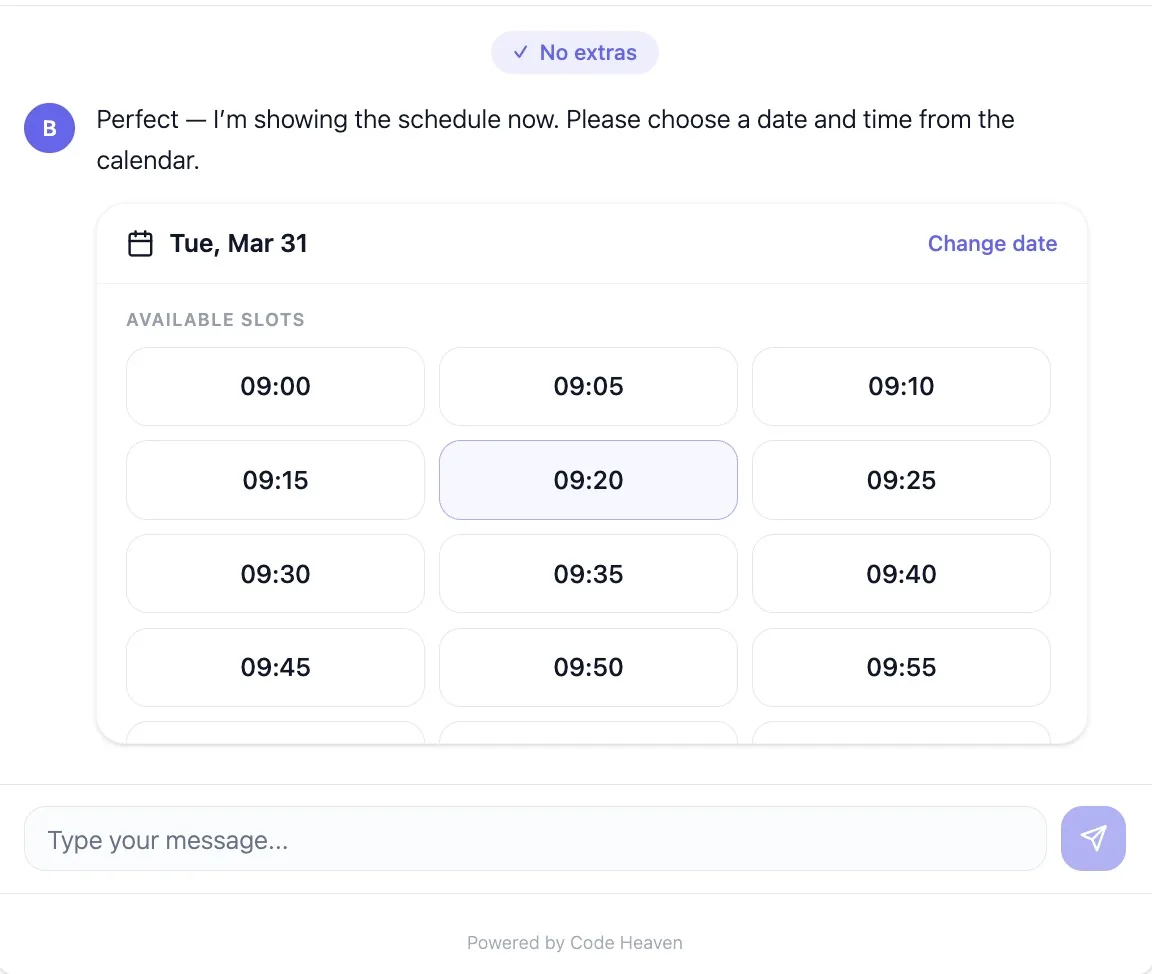
Boo AI adapts the flow based on what the customer says — showing time slots after a date is mentioned.
Uncertainty handling: When customers are vague, Boo AI asks clarifying questions with visual options. If someone says "I need something for my back," it presents relevant services (massage, physiotherapy, chiropractic) as selectable cards rather than forcing a text response.
Confirmation: Before any booking is finalized or payment processed, Boo AI shows a summary card with all details and a confirm button. On the admin side, every write/delete action prompts a confirmation dialog.
Benefits for Business Owners
Agentic booking changes the operational side of appointment management in three significant ways:
Less time on admin. Instead of clicking through admin screens to check schedules, pull revenue reports, or update services, you type a question in chat and get an answer. "How many appointments do we have tomorrow?" takes two seconds instead of thirty.
Fewer missed bookings. When the booking experience is conversational instead of form-based, customers complete more bookings. The AI handles questions, resolves confusion, and keeps the momentum going — unlike a form where any confusion means an abandoned tab.
Higher payment conversion. In-chat payment eliminates the redirect that causes drop-offs. The customer confirms their booking and pays in the same conversation, without navigating to a separate page.
For businesses running Booknetic, Boo AI adds agentic capabilities without requiring any migration or system change. You install the plugin, enter your license key, and your existing Booknetic setup gains AI-powered booking and management. See pricing details here.
Benefits for Customers
From the customer perspective, agentic booking solves the frustrations that traditional forms create:
Natural communication. Customers describe what they want in their own words instead of decoding a form. "I need a 30-minute consultation sometime next week" is faster and easier than clicking through service dropdowns, calendar widgets, and time slot grids.
Immediate answers. Questions during the booking process get answered instantly. "Does this service include X?" or "Can I see a different staff member?" — the AI handles it inline instead of requiring a separate support ticket or phone call.
Seamless mobile experience. Chat interfaces work naturally on mobile devices. No pinching to zoom on date pickers, no cramped form fields, no horizontal scrolling. The booking conversation flows like any messaging app.
Everything in one place. From initial question to confirmed appointment to completed payment — the entire journey happens in a single conversation. No page redirects, no context switching, no "where was I?" moments.
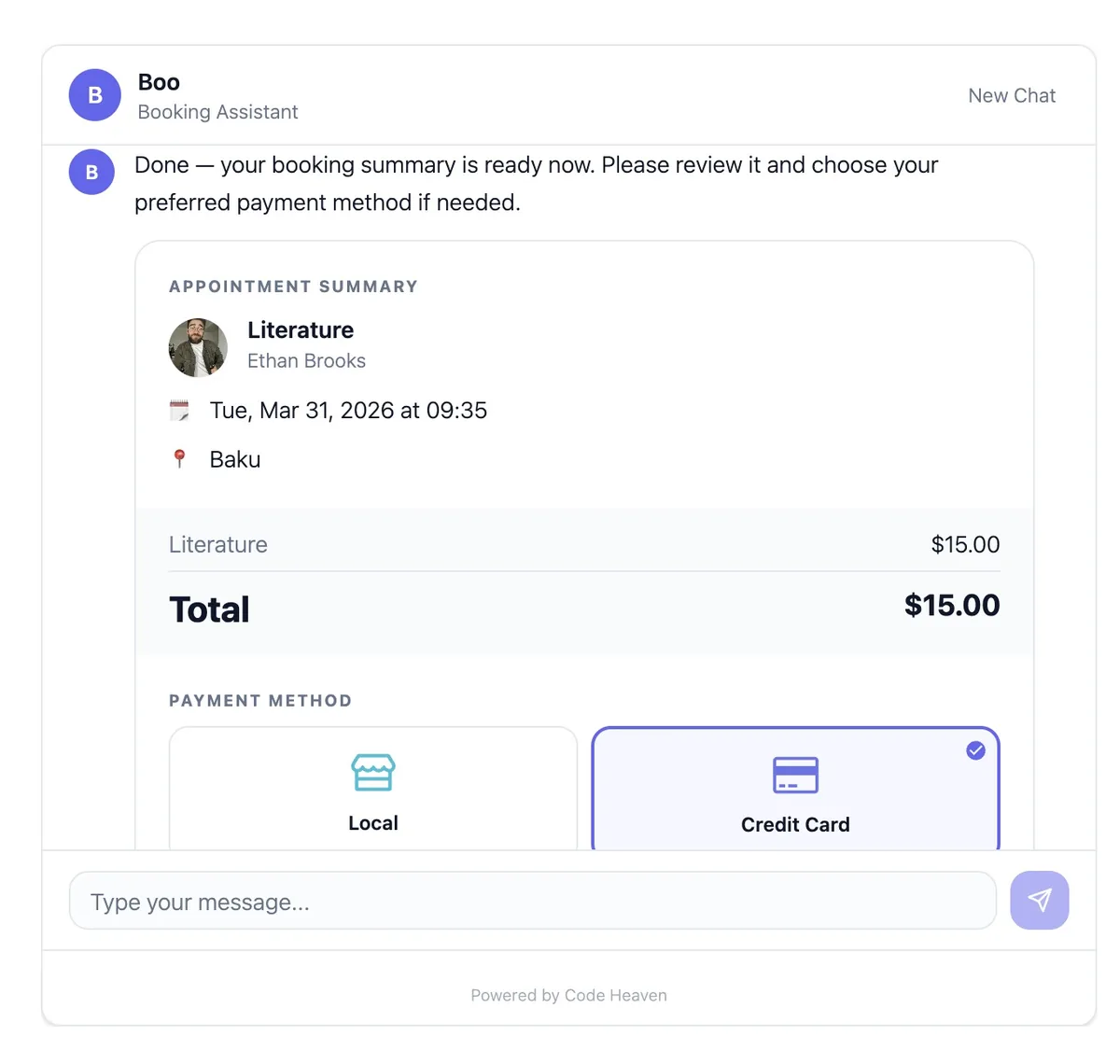
The complete booking flow on mobile — summary, pricing, and payment method selection in chat.
The Future of Appointment Scheduling
Agentic booking is not a trend — it is a structural shift in how businesses and customers interact around appointments. Here is where this is heading:
Voice-first booking. As AI voice models improve, the same agentic capabilities that work in chat will work over the phone. Businesses will have AI receptionists that handle scheduling calls 24/7 with the same data access and action capabilities.
Proactive outreach. Instead of waiting for customers to book, agentic systems will reach out — reminding patients about overdue check-ups, suggesting rebookings based on service history, and offering open slots during slow periods.
Cross-platform presence. Agentic booking will extend beyond the website into WhatsApp, Instagram DMs, and SMS. The AI maintains the same data access regardless of the communication channel.
Deeper business intelligence. As agentic systems handle more interactions, they accumulate valuable data about customer preferences, peak times, popular services, and revenue patterns. This feeds back into smarter recommendations and business insights.
The transition from forms to agentic booking mirrors broader shifts happening across every software category. Users expect to interact with systems conversationally, and they expect those systems to take action — not just display information.
For WordPress businesses using Booknetic, Boo AI brings agentic booking today. It is not a prototype or a coming-soon feature — it is a production-ready system with real-time data access, 31 admin tools, interactive customer booking, and in-chat payment.
The form had a good run. The conversation is better.